ABOUT DIALOGOS
The Dialogos Way is, in its simplest sense, about a group of people meeting in genuine, open and reflective dialogue about topics that matter in private and public life. We start the process in concrete, lived experience.

The core is then to think openly and philosophically together about one or more phenomena. In the process, the ability to reflect on one's own and others' experiences is developed, to listen and ask questions, think critically, see multiple sides of an issue, and meet the world and other people with respect, openness, and dialogical presence.
Through participation in philosophical dialogues over time, we get to know ourselves and each other on a deeper level. It is deeply meaningful for the person or people who participate, regardless of whether they are children, youth or adults, and regardless of their status and position.
Dialogos has power in school classrooms, professional communities and leadership groups, as well as in multicultural and multi-religious contexts, in leadership development and team building in business, in volunteering, in political organizations and in institutions. The greater the cultural, religious and political differences in the group, the more exciting and life-transforming the philosophical dialogues can be.

Deeper insight – Shared understanding – Better relationships
An example from practice
Let me give an example from a Dialogos project (Project Education and Value Enhancement) with employees at a high school.
This day, the employees of the Technology and Industrial Studies Section (TIF) were to reflect together, and I began the day by asking the group what they had in common. The themes were listed on a flipchart. I then asked them to formulate philosophical questions based on the themes, after reviewing what such questions were. The question the group, which mostly consisted of mature men (and a couple of young women), ended up choosing was: “How can we contribute to the students’ life skills through our work at TIF?”
The participants were asked to find a concrete personal example of a time when they experienced contributing to students' life skills. They then shared this in turn, after which they chose one example that we went into more deeply. This was through philosophical reflection. Towards the end of the day, which lasted from 08:30-15:30, I asked the participants to choose two picture cards from a pile I had laid out on a large table. One card was to illustrate the expectation they had entering the day, and the other how they had experienced the day, and what they were left with now that it was coming to an end.
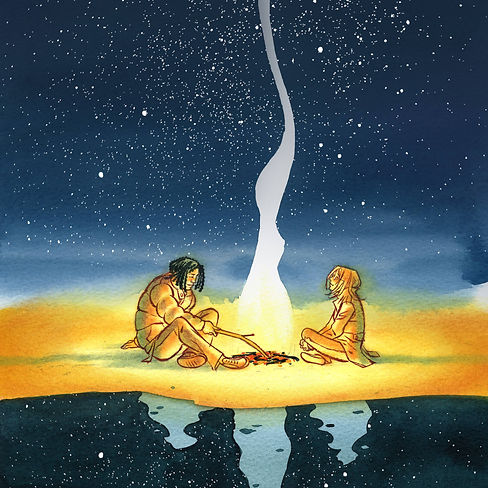
One of the participants first showed the expectation card. It had a picture of a clock. “Before we came here today, I was sure that the day was going to be very long. Sitting here for seven hours seemed almost unbearable,” he said. “But then the day became incredibly exciting,” he continued, showing the second card, which had a picture of two people sitting by a fire inside a teepee tent. “We kind of sat around a fire, smoked peace pipes and sent smoke signals to each other,” he said.
“Many of us have worked together for many years, but we have never talked to each other as deeply as we did today. We have gotten to know each other in a completely different way.” Time had also passed very quickly, he felt. It felt as if we had just arrived here. The others echoed his sentiments, describing similar experiences of the day.
The example is not unique. Often people do not remember much of the content of the philosophical dialogue work, but they do remember the experience of community and the feeling they are left with.